72 Hours of Critical RCEs: PHP, Java4Shell and NGINX2Root
Three consecutive days of critical RCE advisories hit OpenJDK (Java4Shell), NGINX (NGINX2Root) and PHP (seven CVSS 9.2 fixes). Versions, workarounds and triage commands.
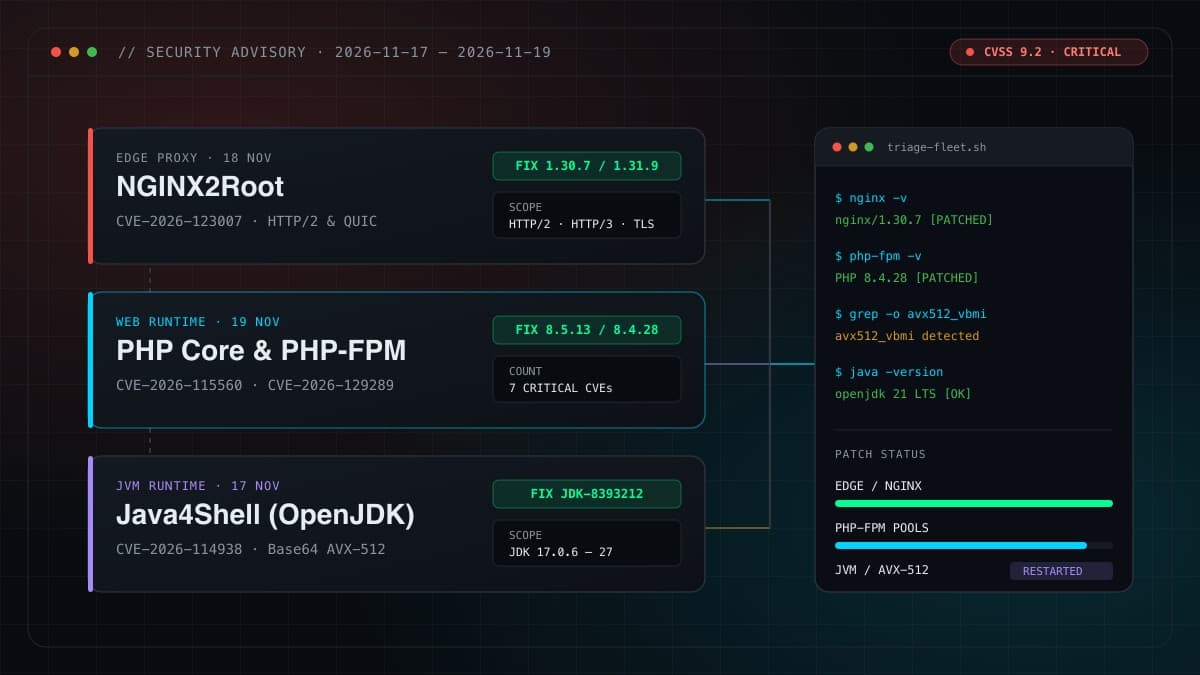
Between 17 and 19 November 2026, three critical remote code execution waves hit the core Linux web stack back to back: Java4Shell in OpenJDK on Tuesday, NGINX2Root across NGINX Open Source and NGINX Plus on Wednesday, and seven critical PHP vulnerabilities today. If you run internet-facing Linux servers, all three layers of a typical production stack now require an immediate patch window.
Package installation alone does not close these vulnerabilities. After upgrading, restart every running nginx master/worker process, every php-fpm pool (or Apache mod_php), and every affected JVM process, then verify the live version in memory.
19 November (Today): PHP ships seven critical 9.2 CVEs
Less than a month after October's emergency PHP2Shell release (covered in our October PHP security roundup), the PHP project shipped another critical patch wave today across every maintained branch. Seven vulnerabilities rated 9.2 on CVSS v4.0 touch session handling, PHP-FPM, the core engine and the date extension.
CVE-2026-115560("phpAfterShell"): a session upload progress serializer mismatch allowing an attacker to write session data in one serialization format and decode it with another, opening a path to RCE when chained with an object gadget chain.CVE-2026-129289(PHP-FPM request smuggling): allows an unauthenticated attacker to achieve PHP code execution in a single request where a reverse proxy reuses FastCGI connections (fastcgi_keep_conn on) and an application endpoint opensphp://inputwithout draining the full request body.CVE-2026-129481,CVE-2026-129182andCVE-2026-129474: use-after-free and incomplete-fix flaws in session shutdown and global engine state handling.
Patched releases are PHP 8.5.13, 8.4.28, 8.3.37 and 8.2.36 (alongside the 8.6.0 release). If an immediate upgrade is blocked on a legacy host, keep session.upload_progress.enabled=0 across all SAPIs and temporarily disable fastcgi_keep_conn in Nginx upstream definitions until PHP-FPM is updated. Also keep the calendar in view: PHP 8.2 reaches end of security support on 31 December 2026, six weeks from today.
18 November: NGINX2Root hits HTTP/2, HTTP/3 and TLS
Yesterday, F5 published an urgent out-of-band advisory for NGINX Open Source (1.19.7 through 1.31.8) and NGINX Plus covering multiple unauthenticated memory-corruption and use-after-free bugs tracked collectively as "NGINX2Root" because worker-level code execution can be chained with an unpatched Linux kernel LPE for full root compromise.
CVE-2026-123007(Critical, public PoC): integer overflow and out-of-bounds heap write in NGINX's HTTP/2 flow-control implementation over TLS, enabling heap corruption and RCE.CVE-2026-123633(Critical): use-after-free triggered when NGINX proxies HTTP/2 requests to an upstream and connection draining closes an active client connection under worker connection pressure.CVE-2026-121810: use-after-free during HTTP/3 (QUIC) connection draining while creating streams and routing upstream requests.CVE-2026-123634andCVE-2026-113425: use-after-free flaws in DNS resolver waiting-list processing (with subrequests/mirror directives) and mail proxy authentication.CVE-2026-118899(High): denial of service forcing an NGINX worker into an infinite loop while reading a request body over TLS 1.3.
Upgrade immediately to NGINX Open Source 1.30.7 (stable) or 1.31.9 (mainline), or the corresponding NGINX Plus builds (37.0.8.1 / 37.3.0.1 and newer). Where an edge load balancer cannot be upgraded inside the next hour, temporarily disabling http2 and http3 (QUIC) on public listeners removes the primary RCE attack surface while you schedule the binary rollout. Verify your Linux kernel patch level on the same host so a worker compromise cannot escalate to root.
17 November: Java4Shell (CVE-2026-114938) in OpenJDK
Tuesday's disclosure, widely dubbed Java4Shell (and often grouped informally with PHP2Shell as "Java2Shell"), is a heap memory-corruption vulnerability (CVSS up to 9.2) in OpenJDK's hardware-accelerated Base64 decoder. Malformed Base64 input sequences cause the vectorized decoder to miscalculate output bounds, leading to out-of-bounds memory reads or writes and potential RCE.
- Affected runtimes: OpenJDK and Oracle Java SE from
17.0.6through27(including LTS lines 17, 21 and 25). Java 8 and Java 11 are not affected because they lack the vulnerable x86-64 decode stub. - Hardware scope: only x86-64 hosts with
AVX-512 VBMIsupport (Intel Xeon Ice Lake or newer, AMD EPYC Zen 4 or newer) execute the vulnerable path. ARM64 and older x86-64 CPUs are unaffected. - Common exposed workloads: Jenkins, Jira, Confluence, Keycloak, Tomcat and Spring services decoding untrusted headers, tokens or payloads.
Oracle and OpenJDK distributions shipped fixes on 17 November under JDK-8393212 (OpenJDK 27.0.1.1+ and vendor LTS backports for 17, 21 and 25). If an application cannot take a JDK upgrade today, add -XX:+UnlockDiagnosticVMOptions -XX:-UseBASE64Intrinsics to the JVM startup flags and restart the service. As an alternative on x86-64-only fleets, -XX:UseAVX=2 also avoids the vulnerable stub, but never apply UseAVX globally across mixed x86-64/ARM64 clusters because ARM64 JVMs will refuse to start.
10-minute fleet triage script
Before scheduling changes, establish what is actually running on every host rather than trusting inventory notes. The snippet below checks installed versions, active NGINX HTTP/2 or FastCGI keep-alive directives, and whether the host CPU exposes avx512_vbmi:
# 1. Edge proxy (NGINX) and exposed directives
nginx -v 2>&1 || true
grep -RniE 'http2|http3|quic|fastcgi_keep_conn' /etc/nginx/ 2>/dev/null | head -n 30

# 2. PHP CLI and FPM binaries
php -v 2>/dev/null | head -n 1 || true
command -v php-fpm >/dev/null && php-fpm -v | head -n 1
ls /usr/sbin/php-fpm* 2>/dev/null | xargs -r -I{} sh -c 'echo -n "{}: "; {} -v | head -n 1'

# 3. Java runtime + AVX-512 VBMI hardware exposure
java -version 2>&1 | head -n 2 || true
grep -m1 -o 'avx512_vbmi' /proc/cpuinfo && echo "CPU exposes AVX-512 VBMI (Java4Shell in scope)" || echo "No AVX-512 VBMI detected"

# 4. Kernel version (check LPE patch level alongside NGINX2Root)
uname -r
Recommended patch order
When three layers break in 72 hours, sequence matters. Following the prioritization discipline from our CVE triage guide, patch from the outside in:
- Priority 1 — Public NGINX edge proxies and ingress controllers: upgrade to
1.30.7/1.31.9(or vendor backport), test withnginx -t, reload/upgrade the master binary, and confirm Linux kernel patches are current. - Priority 2 — Internet-facing PHP stacks: upgrade to
8.5.13/8.4.28/8.3.37/8.2.36, verifysession.upload_progress.enabled=0, restart every PHP-FPM pool and Apache worker, and audit Nginxfastcgi_keep_connblocks. - Priority 3 — OpenJDK 17–27 workloads on AVX-512 VBMI hosts: deploy patched JDK packages or roll out
-XX:+UnlockDiagnosticVMOptions -XX:-UseBASE64Intrinsicswith a controlled restart. - Priority 4 — Post-patch verification: inspect
/var/log/nginx/error.log, FPM crash logs and JVMhs_err_pidfiles for unexpected worker restarts or malformed HTTP/2 and Base64 probes from the last 48 hours.
Keeping emergency patch waves calm
Three critical advisories in a single week are a stress test for backups, staging parity and rollback discipline. If your team is short-handed today or wants a senior Linux engineer to handle the triage, zero-downtime rollout and log verification across your fleet, our 24/7 incident response and security hardening teams in Prague can step in within the hour. Reach us directly via our contact page.
Sources
- PHP November 2026 security releases (8.5.13, 8.4.28, 8.3.37, 8.2.36): https://www.php.net/archive/2026.php
- F5 / NGINX out-of-band advisory (CVE-2026-123007, CVE-2026-123633, CVE-2026-121810, CVE-2026-123634, CVE-2026-113425, CVE-2026-118899): https://my.f5.com/
- NVD entries: https://nvd.nist.gov/vuln/detail/CVE-2026-114938 and https://nvd.nist.gov/vuln/detail/CVE-2026-123007
- PHP supported versions and 8.2 EOL schedule: https://www.php.net/supported-versions.php